Introduction
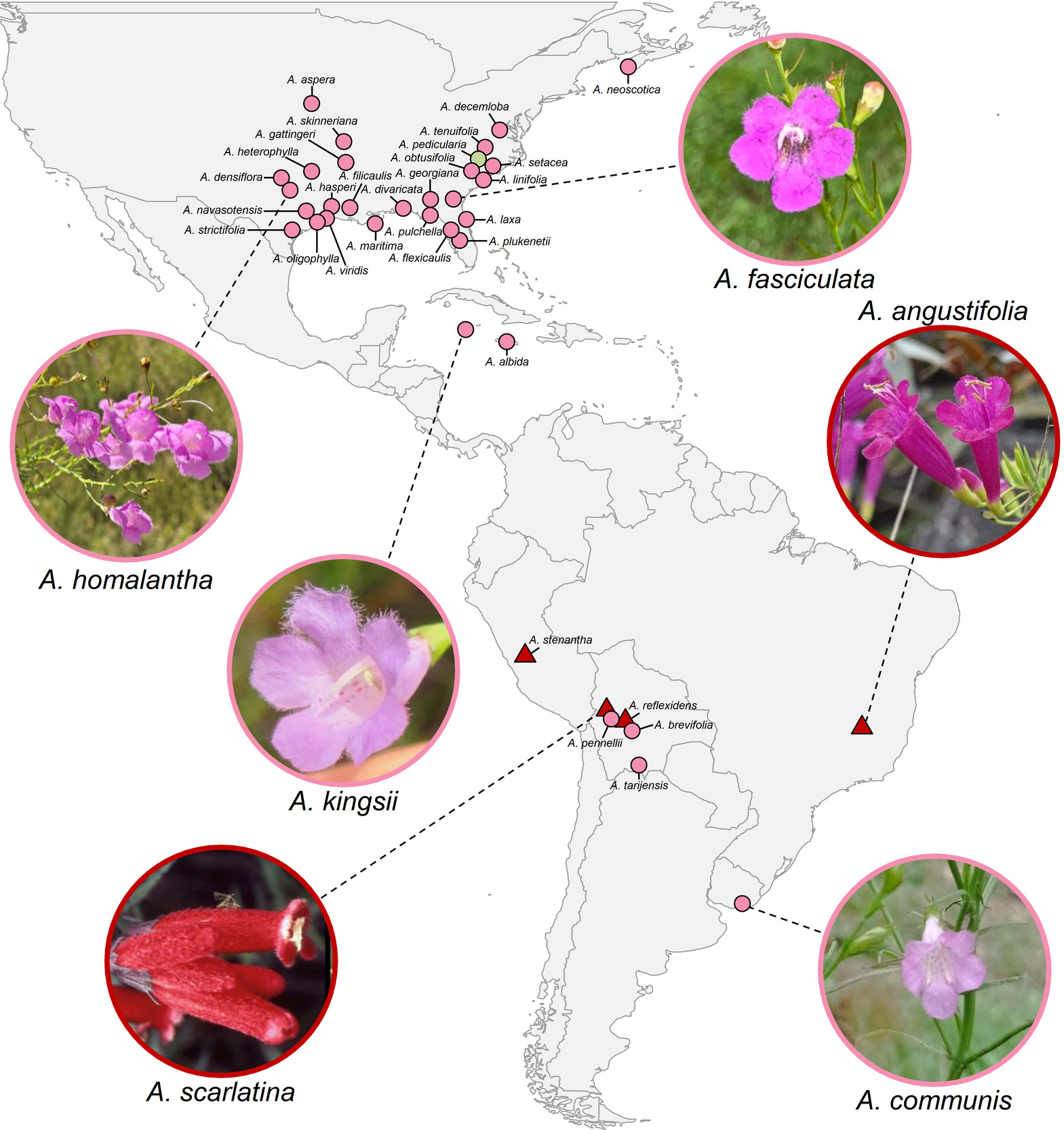
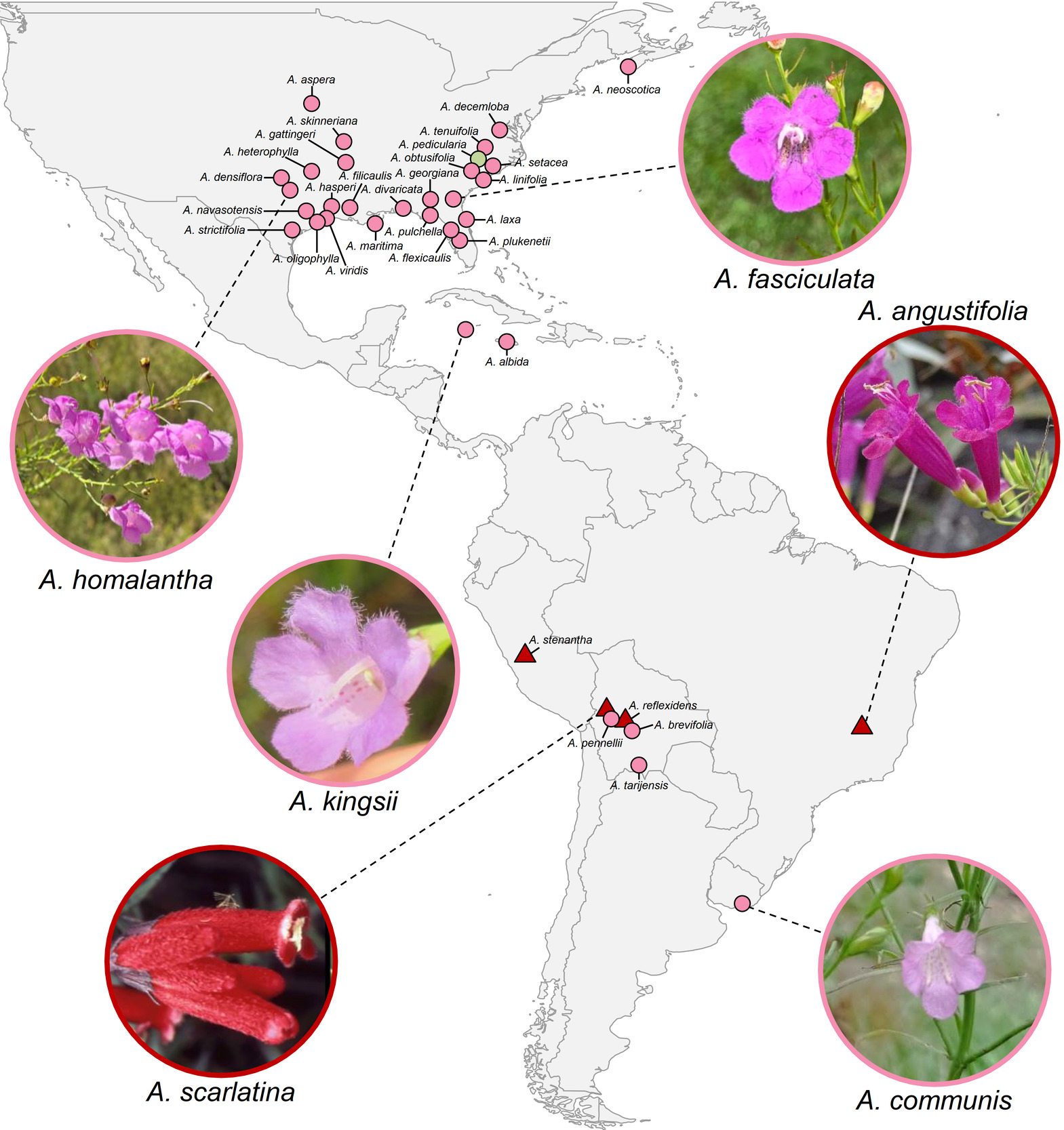
Agalinis Raf. (Orobanchaceae), the false foxgloves, comprises about 70 species distributed across the Americas, from Canada to Argentina and Chile. About half of its diversity occurs in North America, mainly in the eastern United States, and the other half in South America, where the genus has centers of diversity in the northern Andes and in the highlands of southeastern Brazil. A densely sampled phylogeny based on six plastid and four nuclear regions placed Esterhazya within the South American clade of Agalinis (Latvis et al. 2024), and the genus now includes five additional species (Souza et al. 2025). Biogeographic reconstruction suggests that Agalinis is about 20 million years old and likely originated in eastern North America, followed by migration into South America, with subsequent species radiations in the Andes and Brazil (Pezzi et al. 2026). Migration scenarios through the Andes and/or South American grasslands remain unclear. In addition to recent ‘dispersification’, the parallel rapid radiations in South America are associated with changes in pollinators and life-history strategies (Pezzi et al. 2026). In North America, all species are bee-pollinated, and most are annuals, whereas in South America, Agalinis includes both bee- and hummingbird-pollinated species (Fig. 1), and most are perennials. South American Agalinis therefore offers a unique opportunity to study the genetic basis of rapid trait evolution during an ongoing species radiation, particularly the roles of ancestral polymorphism sorting and hybridization in the origin of hummingbird pollination. Moreover, many of the ~70 described species have highly restricted distributions in both North and South America, and in the United States several are considered imperiled in at least one state. Here, we sequenced and assembled the genomes of 36 Agalinis species and Aureolaria pedicularia using mostly tissue from herbarium specimens. These data will improve our understanding of species relationships and serve as an important genomic resource for the group, supporting species conservation and, together with the chromosome-level reference genome of Agalinis fasciculata (Pezzi and Latvis 2026), studies of genome and trait evolution.
Material and Methods
We sampled tissue from herbarium specimens of the Missouri Botanical Garden Herbarium (MO), the Philecology Herbarium (BRIT), the Shirley C. Tucker Herbarium at Louisiana State University (LSU), the University of Florida Herbarium (FLAS), and the University of North Carolina at Chapel Hill Herbarium (NCU). For A. angustifolia, we collected fresh leaf tissue from a population in Diamantina, Minas Gerais, Brazil (18°16′31.4″S, 43°41′08.2″W) and dried it in silica gel. We deposited a voucher specimen at the Herbarium of the Universidade Federal de Minas Gerais (BHCB). We extracted DNA using a DNeasy kit (Qiagen, Redwood City, CA) following the manufacturer’s instructions. Paired-end libraries were prepared with a TruSeq kit (Illumina, San Diego, CA) and sequenced on an Illumina HiSeq platform (2 × 150 bp). We trimmed adapters and low-quality regions with Trimmomatic v0.33 (Bolger et al. 2014) and assembled the cleaned reads with SPAdes v3.15.4 (Bankevich et al. 2012), followed by a finishing step with Zanfona (Kieras et al. 2021). We assessed assembly completeness with BUSCO v6.1.0 against the eudicotyledons_odb12 dataset (Tegenfeldt et al. 2025).
Results and Data Availability
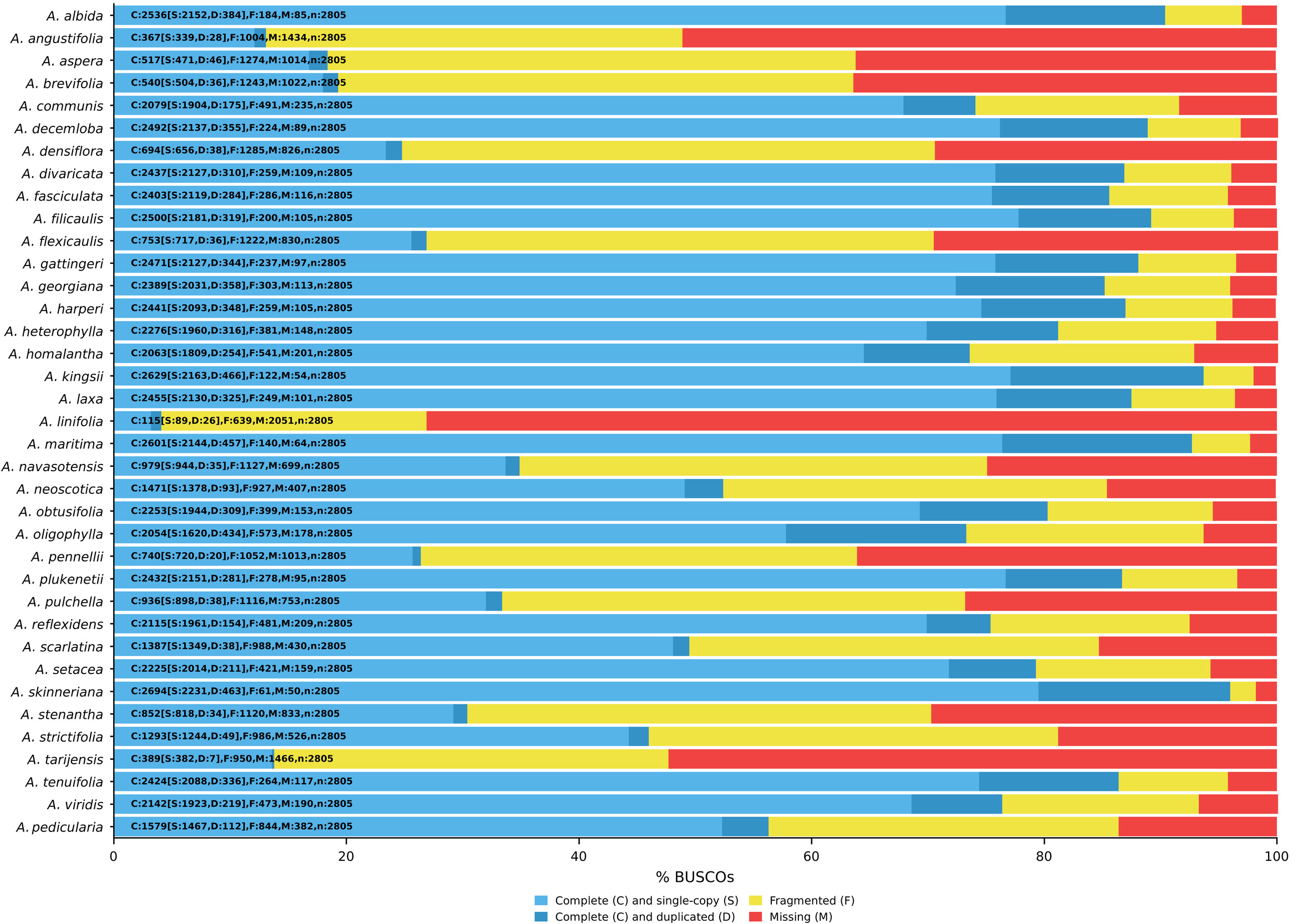
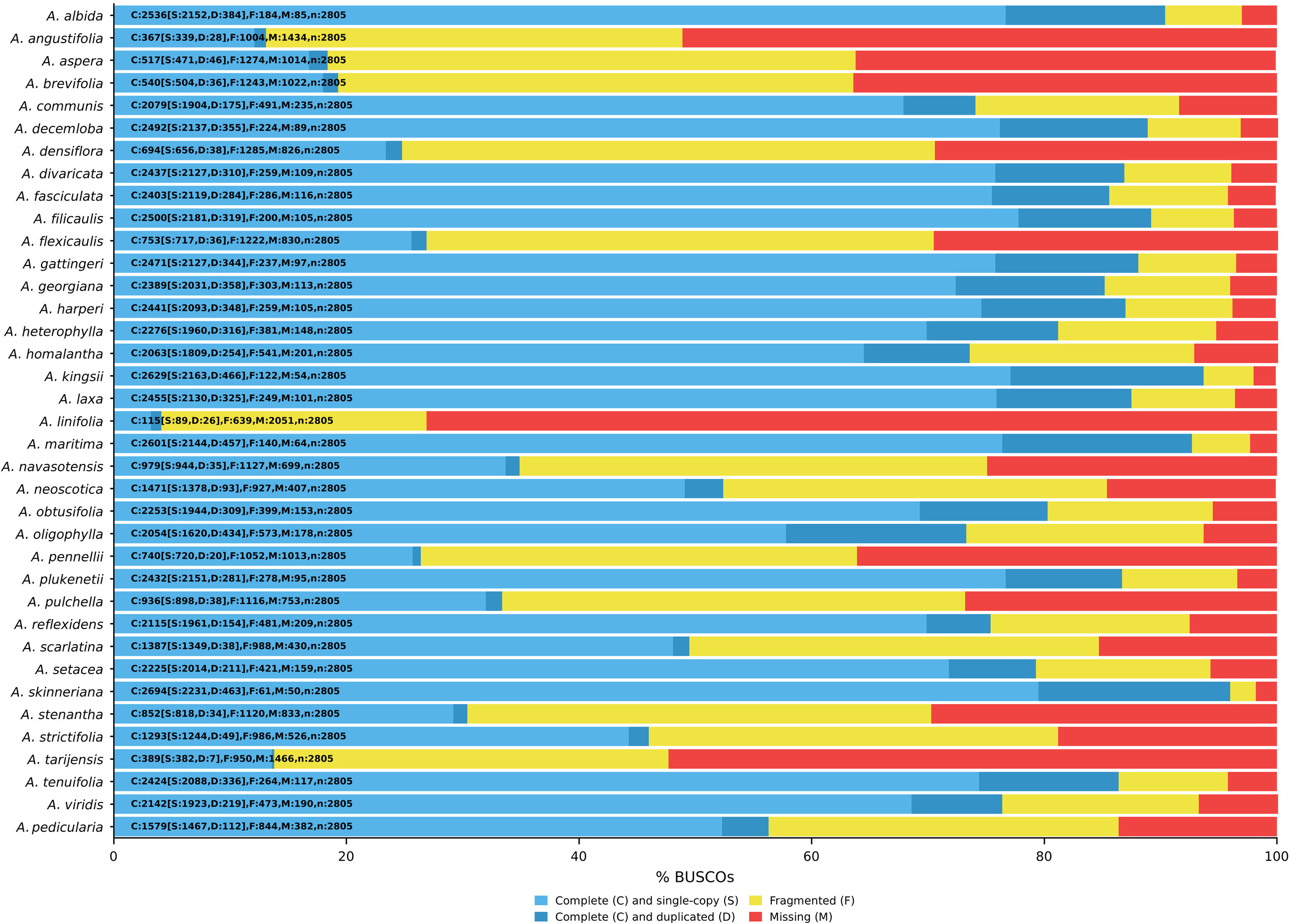
The median and mean ages of the sequenced herbarium specimens were 12 and 17 years, respectively (Table 1), with the oldest specimen being A. divaricata, collected in 1970. Sequencing produced a mean of 258,036,581 raw reads per sample, with the lowest being 143,798,190 for A. tarijensis and the highest being 322,938,654 for A. kingsii. The accession codes for the raw reads and the assembled genomes are provided in Table 1. Although DNA was extracted from historical herbarium specimens (except for A. angustifolia), most genomes showed high completeness, with 24 species exceeding 50% (Fig. 2). These results highlight the value of herbaria as genomic resources, especially for rare and hard-to-collect species.
Acknowledgments
We thank the Missouri Botanical Garden Herbarium (MO), Philecology Herbarium (BRIT), Shirley C. Tucker Herbarium at Louisiana State University (LSU), University of Florida Herbarium (FLAS), and University of North Carolina at Chapel Hill Herbarium (NCU) for access to the specimens sampled. We also thank the Federal University of Minas Gerais Herbarium (BHCB) for allowing us to deposit vouchers of A. angustifolia. Plant material of A. angustifolia was collected under SISBIO/ICMBio license 96764-1 and exported under SisGen registration A2898C1.
Funding
Sequencing was funded by Iridian Genomes (grant #IRGEN_RG_2021-1345). Fieldwork for the collection of A. angustifolia was supported by University of Arkansas start-up funds for M.L.