Introduction
The Mexican Tiger Irises (genus Tigridia Juss.) are monocots endemic to Mexico that have diversified along the Mexican Transition Zone, a key geographic region of overlap between the Nearctic and Neotropical biotas. Tigridia exhibits striking diversity in floral color, patterning, and morphology that results in the attraction of a wide array of pollinators including hummingbirds, bees, and flies. These floral features also contribute to many Tigridia species being highly coveted in the ornamental trade. Phylogenetic relationships within Tigridia and among its sister lineages are contentious, obfuscating our understanding of the evolutionary history of this charismatic group of monocots. Here we present 38 high-quality genomes for Tigridia and closely related taxa (Figure 1), including species currently placed in the genera Ainea, Alophia, Cardiostigma, Cipura, Cobana, Colima, Eleutherine, Herbertia, Larentia, Nemastylis, and Sessilanthera; with Trimezia selected as an outgroup for evolutionary analyses. These resources will establish a foundation for future phylogenomic and comparative studies to explore the evolution of floral traits within the group, ultimately contributing to our understanding the diversification and endemism of flora that inhabit the Mexican Transition Zone.
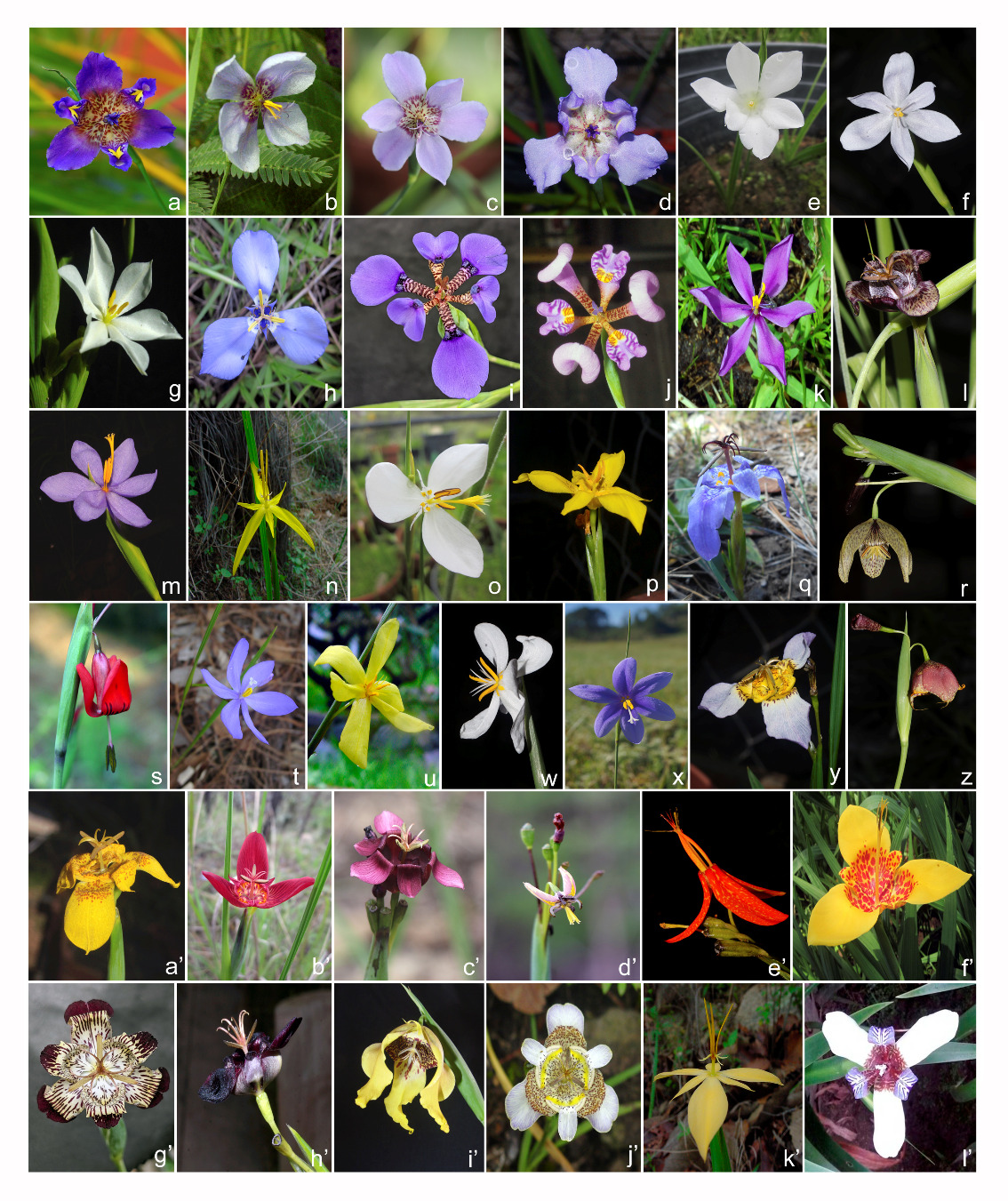
Figure 1.Species of Iridaceae.
- Alophia drummondii (Graham) R.C. Foster (Munguía-Lino et al. 1105, Road to Pinoltepec, Emiliano Zapata, Veracruz, Mexico); b. Alophia intermedia (Ravenna) Goldblatt (Rodríguez & Castro 5788, Tepic, Nayarit, Mexico); c. Alophia silvestris (Loes.) Goldblatt (Munguía-Lino et al. 1290, Balancán, Tabasco, Mexico); d. Alophia veracruzana Goldblatt & T.M.Howard (Munguía-Lino et al. 1113, La Tunilla, Alvarado, Veracruz, Mexico); e. Cipura campanulata Ravenna (Munguía-Lino et al. 29, Corralejo, Taxco de Alarcón, Guerrero, Mexico); f. Cobana guatemalensis (Standl.) Ravenna (Rodríguez et al. 8518, Cobán, Alta Verapaz, Guatemala); g. Eleutherine latifolia (Standl. & L.O.Williams) Ravenna (Rodríguez & L. Ortiz-Catedral 3167, Cerro de las Animas, Catemaco, Veracruz, México); h. Herbertia lahue (Molina)Goldblatt (Munguía-Lino et al. 365, Lavras do Soul, Río Grande Do Soul, Brazil); i. Larentia mexicana (C.V.Morton & R.C.Foster) Goldblatt (Rodríguez & Munguía-Lino 7453, Cerro Colorado, La Huerta, Jalisco, Mexico); j. Cypella rosei R.C.Foster (Rodríguez et al. 8444, Compostela, Nayarit, Mexico); k. Nemastylis tenuis (Baker) Benth. & Hook.f. ex S.Watson (Munguía-Lino et al. 702, El Cuarenta, Tlajomulco de Zuñiga, Jalisco, Mexico); l. Tigridia bicolor Molseed (Rodríguez et al. 2845, San Cristóbal Suchixtlahuaca, Oaxaca, Mexico); m. Tigridia coerulea Goldblatt (Munguía-Lino et al. 1080, La Campana, Atenguillo, Jalisco, Mexico); n. Tigridia convoluta (Ravenna) Goldblatt (Rodriguez et al. 6314, road to Tecomán, Colima, Mexico); o. Tigridia conzattii (R.C.Foster) Goldblatt (Rodriguez & Ortiz-Catedral 2948, Santiago Tenango, Oaxaca, Mexico); p. Tigridia dugesii S.Watson (Munguía Lino et al. 637, Pinal de la Venta, Zapopan, Jalisco, Mexico); q. Tigridia durangensis Molseed ex Cruden (Noriega & González-Gallegos 610, Quebrada de Santa Bárbara, Pueblo Nuevo, Durango, Mexico); r. Tigridia ehrenbergii (Schltdl.) Molseed (Rodríguez et al. 6236, San Pedro Guadalupe, Zumpahuacán, Estado de México, Mexico); s. Tigridia flammea (Lindl.) Ravenna (Rodríguez & Christian Briseño 4172, El Salto del Agua, Morelia, Michoacán, Mexico); t. Tigridia fosteri Goldblatt (Rodriguez et al. 5154, heading to Tumbisca, Morelia, Michoacán, Mexico); u. Sessilanthera heliantha (Ravenna) Cruden (Rodríguez & Christian Briseño 3974, Palo Blanco, Guerrero, Mexico); w. Tigridia latifolia (Weath.) Goldblatt (Munguía-Lino & Rodríguez 283, Iguala-Cuernavaca free highway, Taxco de Alarcón, Guerrero, Mexico); x. Tigridia longispatha (Herb.) Goldblatt (Munguía-Lino & López-Pérez 1283, Parque Nacional los Azufres, Ciudad Hidalgo, Michoacán, Mexico); y. Tigridia mariaetrinitatis Espejo & López-Ferr (Munguía-Lino & López-Pérez 1052, Chalcatongo de Hidalgo, Oaxaca, Mexico); z. Tigridia meleagris G.Nicholson (Munguía-Lino & López-Pérez 858, Trejos, Ixtlahuacán del Río, Jalisco, Mexico); a’. Tigridia mexicana Molseed (Munguía-Lino & López-Pérez 858, El Durazno, Valle de Bravo, Estado de México, Mexico); b’. Tigridia mortonii Molseed (Munguía-Lino & Vázquez-García 188, Sierra de Nanchititla, Luvianos, Estado de México, Mexico), c’. Tigridia multiflora (Herb.) Ravenna (Munguía-Lino & López-Pérez 1414, Cerro el Tajo, Zapopan, Jalisco, Mexico); d’. Tigridia oaxacana (Molseed) Goldblatt (Munguía-Lino & López-Pérez 1375, Ixpantepec Nieves, Oaxaca, Mexico); e’. Tigridia orthantha (Lem.) Ravenna (López-Pérez 204, Llano de las flores, San Juan Atepec, Oaxaca, Mexico), f’. Tigridia pavonia (L.f.) Redouté (Munguía-Lino et al. 245, San Sebastián de las Grutas, Oaxaca, Mexico); g’. Tigridia potosina López-Ferr. & Espejo (Munguía-Lino et al. 1233, Llano de la Garza, Xilitla, San Luis Potosí, Mexico), h’. Tigridia pugana Aarón Rodr. & Ortiz-Cat (Munguía-Lino et al. 1079, Puerto La Campana, Atenguillo, Jalisco, Mexico); i’. Tigridia purpusii Molseed (Rodriguez et al. 5154, in front of African Safari zoo, Puebla, Mexico); j’. Tigridia tepoxtlana Ravenna (Rodríguez et al. 5203, San Juan Tlacotenco, Tepoztlán, Morelos, Mexico); k’. Tigridia tuitensis (Aarón Rodr. & Ortiz-Cat.) Goldblatt (Ramírez-Delgadillo & Rodríguez 2961, Cabo corrientes, Jalisco, Mexico); l’. Trimezia candida (Hassl.) Ravenna (Rio Grande do Soul, Brazil). Photos of A. Rodríguez (b, g, n, s, t, u, i’, j’, k’), G. Munguía (e, h, o, g, c’, d’, f’,´l), J. Gónzalez (q), J. López (a, c, d, f, k, l, m, p, r, w, t, y, z, a’, e’, h’ ), and P. Rivas (i, g’).
Methods
DNA was extracted from leaves that were collected from living material and subsequently dried and stored in silica, with approximately 10-15 mg of leaf tissue used per extraction. Voucher specimens for each species are indicated in Table 1; most vouchers were deposited in the herbarium of the Instituto de Botánica of the Universidad de Guadalajara (IBUG) with Trimezia candida collected from the Liberty Hyde Bailey Conservatory at Cornell and deposited in the L. H. Bailey Hortorium Herbarium (BH). Each DNA extraction was performed using the Qiagen DNEasy genomic extraction kit using the manufacturer’s protocol. Paired-end sequencing libraries were constructed using the Illumina TruSeq kit according to the manufacturer’s instructions. Libraries were sequenced on an Illumina Hi-Seq platform in paired-end, 2 × 150 bp format. The resulting fastq files were trimmed of adapter/primer sequences and low-quality regions with Trimmomatic v0.33 (Bolger et al. 2014). The trimmed sequences were assembled by SPAdes v3.15.4 (Bankevich et al. 2012), screened for foreign contaminants with FCS (Astashyn et al. 2024), followed by a finishing step using Zanfona (Kieras et al. 2021) to scaffold newly generated assemblies based on available genomes from related species. Raw sequencing reads were uploaded to the Sequence Read Archive.
Results and Data Availability
Sequencing files and scaffolded genome assemblies are available on NCBI with the accession numbers listed in Table 1.
Table 1.Species name, herbarium voucher, and accession number for each genome assembly generated.
| Taxon |
Herbarium voucher |
SRA accession number |
| Alophia drummondii (Graham) R.C. Foster |
225037 IBUG |
SRR35942773 |
| Alophia intermedia (Ravenna) Goldblatt |
225038 IBUG |
SRR35975401 |
| Alophia silvestris (Loes.) Goldblatt |
225074 IBUG |
SRR32984463 |
| Alophia veracruzana Goldblatt & T.M.Howard |
225039 IBUG |
SRR35939171 |
| Cipura campanulata Ravenna |
190086 IBUG |
SRR32974603 |
| Cobana guatemalensis (Standl.) Ravenna |
220392 IBUG |
SRR35943150 |
| Cypella rosei R.C.Foster |
225044 IBUG |
SRR35942776 |
| Eleutherine latifolia (Standl. & L.O.Williams) Ravenna |
159937 IBUG |
SRR32974336 |
| Herbertia lahue (Molina)Goldblatt |
197182 IBUG |
SRR35943152 |
| Larentia mexicana (C.V.Morton & R.C.Foster) Goldblatt |
220394 IBUG |
SRR32984341 |
| Nemastylis floridana Small |
188371 IBUG |
SRR35942812 |
| Nemastylis tenuis (Baker) Benth. & Hook.f. ex S.Watson |
159958 IBUG |
SRR32984344 |
| Sessilanthera heliantha (Ravenna) Cruden |
205975 IBUG |
SRR32984464 |
| Tigridia bicolor Molseed |
178573 IBUG |
SRR35921011 |
| Tigridia coerulea Goldblatt |
225040 IBUG |
SRR35942784 |
| Tigridia convoluta (Ravenna) Goldblatt |
189359 IBUG |
SRR35943149 |
| Tigridia conzattii (R.C.Foster) Goldblatt |
159588 IBUG |
SRR32984455 |
| Tigridia dugesii S.Watson |
225048 IBUG |
SRR35921132 |
| Tigridia durangensis Molseed ex Cruden |
222931 IBUG |
SRR35920868 |
| Tigridia ehrenbergii (Schltdl.) Molseed |
156360 IBUG |
SRR35007315 |
| Tigridia flammea (Lindl.) Ravenna |
225050 IBUG |
SRR35943155 |
| Tigridia fosteri Goldblatt |
225042 IBUG |
SRR35943153 |
| Tigridia latifolia (Weath.) Goldblatt |
206212 IBUG |
SRR32984328 |
| Tigridia longispatha (Herb.) Goldblatt |
225041 IBUG |
SRR35943144 |
| Tigridia mariaetrinitatis Espejo & López-Ferr |
224883 IBUG |
SRR35921159 |
| Tigridia meleagris G.Nicholson |
161670 IBUG |
SRR32984512 |
| Tigridia mexicana Molseed |
160421 IBUG |
SRR33339707 |
| Tigridia mortonii Molseed |
225061 IBUG |
SRR36041367 |
| Tigridia multiflora (Herb.) Ravenna |
225062 IBUG |
SRR35921157 |
| Tigridia oaxacana (Molseed) Goldblatt |
225043 IBUG |
SRR35942960 |
| Tigridia orthantha (Lem.) Ravenna |
166124 IBUG |
SRR33339606 |
| Tigridia pavonia (L.f.) Redouté |
94865 IBUG |
SRR32981532 |
| Tigridia potosina López-Ferr. & Espejo |
190633 IBUG |
SRR35007284 |
| Tigridia pugana Aarón Rodr. & Ortiz-Cat |
222391 IBUG |
SRR35924648 |
| Tigridia purpusii Molseed |
225065 IBUG |
SRR36041701 |
| Tigridia tepoxtlana Ravenna |
225068 IBUG |
SRR35921126 |
| Tigridia tuitensis (Aarón Rodr. & Ortiz-Cat.) Goldblatt |
189360 IBUG |
SRR36044440 |
| Trimezia candida (Hassl.) Ravenna |
BH000348917 |
SRR35942914 |
Funding
Funding was provided by Iridian Genomes, grant# IRGEN_RG_2021-1345 Genomic Studies of Eukaryotic Taxa.
Submitted: June 01, 2026 EDT
Accepted: June 01, 2026 EDT