Introduction
The genus Arisaema Mart. (Araceae) comprises more than 200 species of herbaceous understory plants distributed primarily across eastern Asia, with Japan representing a major center of diversity (Murata 2011; Ohi-Toma et al. 2016). Species are notable for their complex reproductive biology, including environmentally mediated sex expression (Scholten and Specht 2025) and specialized pollination systems involving fungus gnats and other dipterans through mushroom mimicry (Kakishima et al. 2019). Within Japan, the Arisaema serratum complex represents a taxonomically challenging group characterized by morphological variation, overlapping distributions, and frequent reports of putative hybridization (Murata and Ohashi 2009; Scholten et al. 2025). These taxa typically occur in shaded forest understories across elevational gradients, where ecological overlap and reproductive plasticity may facilitate gene flow among species (Murata et al. 2018).
Within this complex, Arisaema serratum (Thunb.) Schott is a widespread and morphologically variable species, while A. tosaense Makino and related taxa form a geographically structured complex in western Japan (Murata 2011). Arisaema ehimense J. Murata & J. Ohno, a narrow endemic species restricted to Shikoku Island, was described as a putative hybrid between A. serratum and A. tosaense based on morphological intermediacy. Cytogenetic observations indicate that these taxa are diploid (2n = 28), and A. ehimense exhibits high pollen viability, seed set, and stable population structure leading to its hypothesized status as a homoploid hybrid species (Murata and Ohno 1989). Subsequent allozyme analyses (Maki and Murata 2001) and allele-sharing surveys suggest shared ancestry with both parental taxa, but were inconclusive in resolving its evolutionary origin thus leaving its status as a homoploid hybrid species unresolved (Scholten and Specht 2025).
Despite long-standing interest in hybridization within Arisaema, genomic resources for the genus remain limited, constraining efforts to evaluate patterns of gene flow, lineage divergence, and the genetic basis of reproductive isolation. The availability of reference genome sequences for A. serratum, A. tosaense, and A. ehimense provides an important resource for future studies of reticulate evolution in this system. These genomic data will enable detailed investigation of genome structure, patterns of variation, and candidate loci associated with ecological and reproductive traits, and contribute to broader efforts to understand the role of hybridization in plant diversification (Rieseberg 1997; Payseur and Rieseberg 2016).
Methods
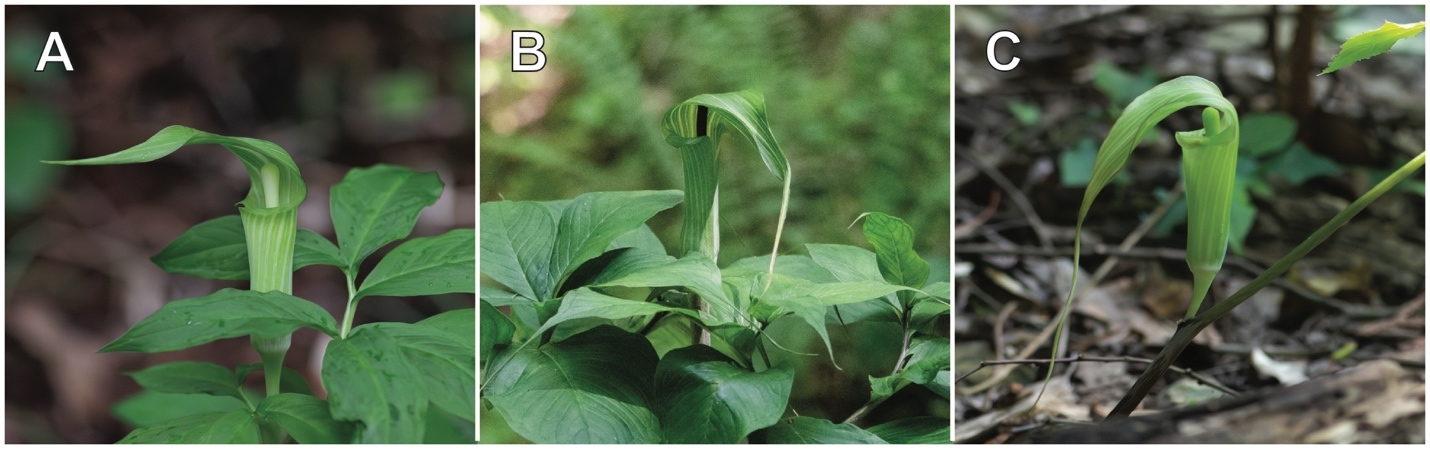
Leaf tissue for genome sequencing was collected from natural populations of Arisaema serratum, A. tosaense, and A. ehimense on Shikoku Island, Japan, in May 2024 (Figure 1). The sequenced individual of A. ehimense was collected on 10 May 2024 from a coastal roadside population in Ehime Prefecture (191 m elevation). The A. tosaense individual was collected on 8 May 2024 from an altitudinal plateau of Mount Saragamine, Kamiukena District (33°43.422′ N, 132°53.107′ E; 951 m elevation). The A. serratum individual was collected on 5 May 2024 from a lowland slope in a Japanese red cedar forest in Kumakogen, Kamiukena District (33°40.236′ N, 132°54.750′ E; 678 m elevation).
_*a._serrat.jpeg)
Fresh leaves of each species were collected in the field and shipped back to Cornell University for data generation and storage at -80℃. Since each individual only had a single leaf or two leaves at the time of collection, there was not enough vegetative material left from the collected sample for sequencing for a herbarium voucher. Therefore, a second individual from the same population was collected to serve as the voucher deposited in the L. H. Bailey Hortorium Herbarium (BH) at Cornell University (Table 1). Frozen leaf material was sent to the Genomics Core Facility at the Icahn School of Medicine Mount Sinai (New York City, USA) for DNA extraction and PacBio HiFi sequencing. DNA was extracted using the NucleoSpin kit (Machery-Nagel, Dueren, Germany), followed by a BluePippin size selection. Library preparation used the PacBio SMRTbell Prep 3.0 (Pacific Biosciences, California, USA) designed for large genomes. A total of three SMRT cells were sequenced on the PacBio Revio to generate HiFi reads for each species.
Adapter sequences were filtered from the raw sequencing files using HiFiAdapterFilt (Sim et al. 2022) with a minimum length of 44 bp and at least a 97% similarity match. HiFiasm v0.25.0-r726 (Cheng et al. 2021) was used to assemble each genome using eight rounds of assembly cleaning and the purge level set at three. Each assembly was scaffolded using Samba (Zimin and Salzberg 2022) as packaged in MaSuRCA v4.1.3 (Zimin et al. 2013) with the cleaned HiFi reads. The scaffolded assemblies were then sorted largest to smallest, keeping only scaffolds that were longer than 1,000 bp using seqkit v2.7.0 (Shen et al. 2016). The sorted genome was then checked for known contaminants and adapter sequencings using the foreign contaminants screener FCS-adaptor and FCS-GX (Astashyn et al. 2024). Cleaned assemblies were then annotated using Helixer v0.3.6 (Holst et al. 2025), which uses Deep Neural Networks and Hidden Markov Models to predict gene models without the need of generating species specific RNA-Seq data. The resulting gff3 file was used to generate CDS and protein sequence files using gffread v0.9.12 (Pertea and Pertea 2020).
Quality of the genome assemblies were assessed with BUSCO v.5.5.0 (Manni et al. 2021) using the embryophyta odb10 library. The LTR Assembly Index (LAI) was calculated using LTR_retriever v2.9.9 (Ou et al. 2018) to assess the contiguity of the assemblies, with draft assemblies having a value 0-10, reference quality 10-20, and gold standard 20 and above. Predicted genes from Helixer were functionally annotated by comparing the predicted genes against the Uniprot/Swissprot, GO, and KEGG databases with BLASTx v2.1.3.0 for nucleotide sequences, and BLASTp v2.13.0 (Camacho et al. 2009) and HMMER v.3.4 (hmmer.org) for protein sequences. Scaffolded genomes have been deposited in NCBI (BioProject PRJNA1443511), while the genomes and annotation files, including coding genes, proteins, and functional annotations are available on Cornell eCommons (Landis et al. 2026).
Results and Data Availability
Total sequencing yield for the three SMRT cells for each species was 115 Gbp for A. ehimense, 155 Gbp for A. serratum, and 173 Gbp for A. tosaense. Average length of HiFi reads were 10,813 bp for A. ehimense, 10,848 for A. serratum, and 11,854 for A. tosaense. Accession information for each sample can be found in Table 1.
Genome assembly stats indicate that all three assemblies are fragmented and not chromosome-scale, but are mostly complete with respect to gene content based on BUSCO scores. The A. ehimense genome was the most fragmented with 62,971 scaffolds and a N50 of 586 Kbp. This species had the largest assembled genome at 8.61 Gbp with a BUSCO score of 88.6% complete, 8.1% fragmented and 3.3% missing (Table 2). Both A. serratum and A. tosaense were more contiguous with 7,742 and 6,443 contigs respectively as compared to A. ehimense, both with N50 values of 3 Mbp. Both the A. serratum and A. tosaense assemblies also had higher BUSCO scores relative to A. ehimense with 93.4% complete (A. serratum) and 92.5% complete (A. tosaense). The A. tosaense genome also had a LAI score of 13.92, indicating that it qualifies as being “reference” quality. The genomes of A. ehimense and A. serratum failed to generate LAI scores.
Helixer predicted between 55,236 and 62,735 genes across the three genomes (Table 2). Functional annotations of the predicted genes showed that 66.4% (41,659/62,735) of the annotated genes of A. ehimense, 69.6% (38,427/55,236) of the annotated genes in A. serratum, and 69.7% (39,736/56,937) of the annotated genes of A. tosaense had known predicted functions.
Funding
This work was supported by funds provided by the Lewis and Clark Fund for Exploration and Research, the Torrey Botanical Society, the Society of Systematic Biologists, the Mario Einaudi Center of International Studies, and the Moore Fund of the L.H. Bailey Hortorium Herbarium. Additionally, the stipend of JS was supported in part by the Tara Atluri '24 Herbarium Engagement Fund.
Acknowledgements
The authors thank Olivia Hullihen and Shun Tanaka for their valuable assistance in preparing the leaf samples during fieldwork; Maya Fridrikh, Irene Salib, and the rest of the Mount Sinai sequencing core for data generation; Jesus Martinez-Gomez for administrative help with genome sequencing; the Cornell BioHPC for computational resources; and Charlie Hale and Zong-Yan Liu for recommending Helixer.